Buying and Managing E-Books for Acquisitions Librarians. Part 2 – Schemes and Packages.

Welcome to the second post in my series, Buying and Managing E-Books for Acquisitions Librarians. Over the coming weeks, I will be pulling back the curtain on the digital supply chain to explore methods of purchase, supplier relationships, and what happens next. Today we are looking at Schemes and Packages

Here is a breakdown of the series so far:

In our previous post, we looked at the foundational elements of e-book procurement: the “who” (suppliers) and the “how” (licences). We explored the delicate balance of choosing between a 3-user licence and a credit model, and the importance of having a robust local selection policy.

However, title-by-title purchasing is only one piece of the puzzle. To build a scalable, responsive collection, we have to look beyond individual transactions. Suppliers frequently sell using models that move away from the one book, one price logic. Welcome to Part 2 – Schemes and Packages.

Image by u_u06cx7dg6j from Pixabay

Read More »

Buying and Managing E-Books for Acquisitions Librarians. Part 1 – Purchasing E-Books.

In the ever-evolving landscape of academic library collections, the shift toward digital has often been framed as a straightforward evolution, a simple migration from shelf to screen. Yet, as any Acquisitions Librarian can tell you, the reality of building a digital collection is a complex dance of licensing, logistics, and strategic negotiation. While our patrons see the convenience of a click, we navigate a labyrinth of platforms, permissions, and pricing models behind the scenes.

Welcome to the first post in my new series, Buying and Managing E-Books for Acquisitions Librarians. Over the coming weeks, I will be pulling back the curtain on the digital supply chain to explore methods of purchase, supplier relationships, and what happens next

My plan is to cover the following elements:

Image by Michael Haderer from Pixabay

Purchasing E-Books

1 – Supplier Type: Aggregators

Aggregators—such as ProQuest (Ebook Central), EBSCO, and VLeBooks—act as the massive department stores of the library world. They host content from thousands of different publishers on a single, unified platform, providing a centralized hub for discovery and management.

Read More »

5 things for University Librarians to think about when exiting a Read and Public agreement

The landscape of UK higher education has recently shifted, with news that terms have been agreed with five major academic publishers via Jisc negotiations. While some might be tempted to view this as a “done deal,” another perspective would describe it as a pragmatic reflection from the sector that further negotiation on terms is simply no longer possible.

The harsh reality is that, given the severe financial challenges facing the sector, many of these agreements will remain fundamentally unaffordable for many institutions. This isn’t just a budgetary squeeze, it is a cliff edge. Difficult decisions regarding the deployment of available funds will need to be made with extreme speed, likely resulting in several institutions withdrawing from at least one major deal. At the University of York, our experience of withdrawing from seven Read and Publish (R&P) agreements as of the beginning of 2025 has shown that there is currently no roadmap or sufficient systemic help for exiting these Big Deals.

To that end, here are 5 key considerations to help navigate the complexities of an R&P exit. These are not exhaustive, nor are they universal, this is simply one University Acquisitions Librarian’s interpretation of a complex and stressful situation, with some practical tips in the hopes that others in a similar situation may find it helpful.

Image by Pexels from Pixabay

Read More »

5 Reasons OERs Could Unlock Opportunities for UK Academic Libraries

Adopt – Adapt – Create

Open Educational Resources (OERs) are freely accessible, openly licensed instructional materials, from full courses and textbooks to videos and images. They can be used, adapted, and shared by anyone. These resources embody the principles of openness and reuse, moving beyond the often restrictive models of traditional publishing.

While OER adoption is widespread in parts of North America and other regions, its integration into core teaching practice across the UK higher education landscape is still nascent. This early stage means that most institutions have significant untapped potential to leverage OER. For UK academic libraries, the traditional custodians of scholarly content, this presents a compelling opportunity to be at the forefront of an innovative movement.

Image by MasterTux from Pixabay

Read More »

Print Books vs E-Books: 5 reasons why print books persist in the digital age

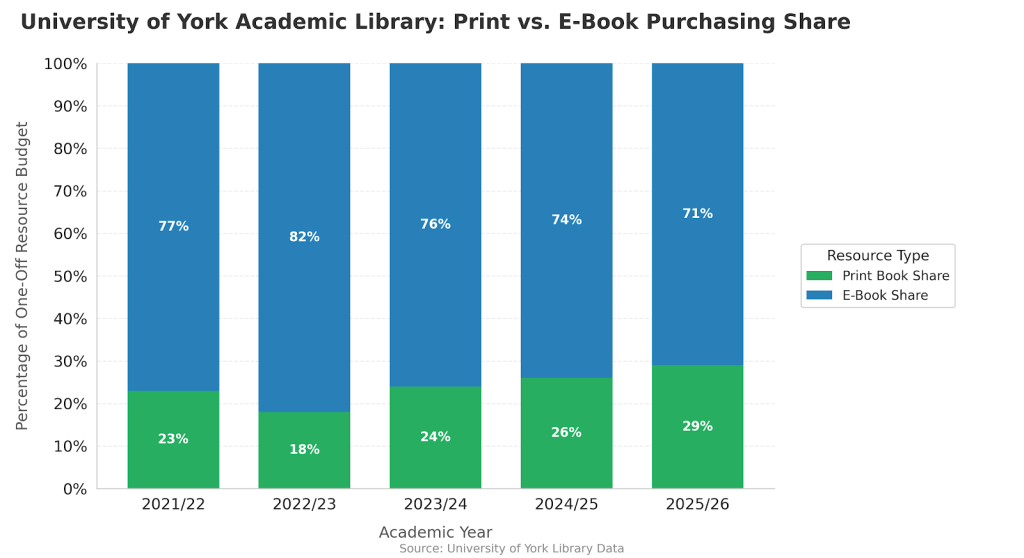
The digital age has fundamentally transformed the academic library, with the acquisition of e-books and online resources becoming the dominant force in collection development. The sheer volume, ease of remote access, and discoverability of electronic resources have undeniably reshaped scholarly research. To illustrate this seismic shift, consider the purchasing data for one-off resources at the University of York , where electronic resources have consistently commanded 70-80% of the total budget in recent years

Read More »

Do Audiobooks Count as Reading? (Spoiler: YES!)

I’ve spent a lot of time thinking about the Great Audiobook Debate. It sounds like a wrestling match in the book club, and honestly, it sometimes feels like one. You know the scene: you’re excited to discuss a new book, and you mention, “Oh, I listened to the audiobook,” only to have someone reply, “So, you didn’t actually read it?” Cue the eye-roll.

It’s an exhausting, circular argument, as old as audiobooks themselves and it’s one of those knotty problems that book lovers and library folks get stuck on.

It’s not as simple as “this one is good” and “this one is bad.” But, since you’re here, my professional opinion is a resounding YES, and you can tell them that a Librarian told you so.

Now, before anyone grabs their pitchforks (or their physical copies of War and Peace), let’s unpack this.

Image by Ri Butov from Pixabay

Read More »

5 Inconvenient Facts All Librarians Should Know About E-Books

During the Covid-19 pandemic, the promise of the digital library became clearer than ever. As physical doors closed, e-books offered a vital lifeline, foregrounding the incredible potential of on-demand access to information and culture. Yet this moment of digital promise also cast a harsh light on the dysfunctional infrastructure, predatory business models, and outdated legal frameworks that govern the lending of digital content.

For librarians on the front lines, the digital dream often clashes with a difficult daily reality. While lending a physical book is a straightforward and established process, licensing a digital one is complex, expensive, and often deeply frustrating. This has ignited a “palpable and widespread dissatisfaction” among library professionals who see a growing disconnect between their public mission and the commercial constraints of the e-book market.

This article uncovers five of the most impactful and often counter-intuitive realities that shape the world of e-lending today, revealing the hidden complexities that exist just beyond the reader’s click.

Image by Eli Digital Creative from Pixabay

Read More »

5 Facts All Librarians Should Know About Interlibrary Loans

The UKSG Insights article ‘Interlibrary loans, subscriptions and copyright in the UK academic library sector’ by my White Rose comrade, from University of Sheffield, Andrew Johnson, is an excellent summary of the current ILL situation, considering legal exceptions and some of the legislative grey areas that exist within the ecosystem.

I would encourage everyone to read it, as an educational and insightful explainer of complicated issues. I would also encourage anyone interested in expanding knowledge in this sphere of Librarianship to use ‘Exceptions for Libraries’ by renowned fonts of ILL knowledge Chris Morrison and Jane Secker as a good practical starting point.

Regarding Interlending, ILL, Interlibrary Loans, or whatever nomenclature you prefer to use, here are 5 facts that all Librarians should know…

Image by Nino Carè from Pixabay

Read More »

EBA v DDA – Which is best?

I posted on Linkedin a while ago about my overall views on EBA schemes, particularly in relation to DDA (or PDA) alternatives. I waffled on and ran out of words, happily now that I’ve set this blog up that is no longer an issue. So here is a post on all things EBA and DDA, happy reading.

What is an EBA?

An Evidence-Based Acquisition (EBA) scheme is a library acquisition model for digital content, most commonly e-books, where the library pays an upfront fee for a set period of time (usually a year) to provide its users with unlimited access to a large collection of titles from a publisher or aggregator.

Read More »