5 Reasons to join the National Acquisitions Group (NAG)

What is NAG

National Acquisitions Group, which will hereafter be referred to as NAG, is a membership organisation involving Librarians (public, academic, and specialist), suppliers, and publishers. Active since 1985, it is focused on providing a voice for everyone associated with the Library supply ecosystem, fostering conversation about general direction and helping to facilitate the sharing of ideas regarding hot topics of the day.

In their own words “For everyone interested in the acquisition management and development of library resources. NAG is run by its members for its membersNAG is a voice for everyone associated with library and information resources – librarians, information officers, publishers and service suppliers – providing leadership and a source of shared expertise for its membership.

Why Are You Promoting It

For the avoidance of doubt, I am completely biased. I was on the NAG Executive Committee for over 5 years and enjoyed the work that I participated in within the group. I have been an alumni/supporter since and strongly believe that it is an excellent, well organised, and highly skilled organisation with an eminently important mission

I am also taking part in the NAG Seminar on Wed 20th and Thu 21st May 2026 in Nottingham. I am talking all about People being better than systems (with a small taster here) and would love to see as many of you there as possible as there is a huge range of excellent presentations, plenarys, and activities going on

All of that notwithstanding, NAG is a worthwhile and important organisation. The main rason why I spent so long working with them and continue to support them is that I strongly believe that this group enriches the sector and, if your institution is not currently a member, it would strongly benefit from joining.

Read More »

Amazon gives the public a taste of the treatment academic libraries have been highlighting for years

For over a decade, the Amazon Kindle has been the poster child for the digital reading revolution. It promised a library in your pocket, a seamless partnership between the tactile world of paper and the convenience of the cloud. But for millions of users clinging to older, perfectly functional devices, that promise has recently curdled. As reported by the BBC, Amazon’s decision to effectively ‘stealth-brick’ older models by removing their ability to access the Kindle Store and receive new ebooks is more than just a hardware sunsetting, it is a public-facing masterclass in the fragility of digital ownership.

While the general public reacts with a mix of confusion and outrage, those within the world of academic and public libraries are experiencing a profound sense of déjà vu. For years, librarians have been the canaries in the coal mine, documenting the steady erosion of consumer rights and the aggressive pivot from ownership to high-cost, restrictive, access models. Amazon’s recent move is not an isolated tech glitch, it is the consumer-facing manifestation of a commercial strategy that has plagued institutional knowledge for a generation.

Image by Pexels from Pixabay

Read More »

People Are Better Than Systems: 5 Reasons Why Human Expertise Trumps Shiny Centralisation

I am really looking forward to presenting about this topic at the NAG Seminar 2026 in Nottingham on May 20th and May 21st (open for bookings now, get signed up and if you aren’t a NAG member, consider joining this fantastic organisation)

At the seminar, I will be talking very specifically about the knowledge and expertise that has been invaluable from our teams at University of York, consider this a teaser article that covers a small fraction of the concepts, ideas, and examples that will be delivered (powerpoint style) to Seminar attendees.

“Centralised systems are best! Do you really need all those spreadsheets? Wouldn’t it be easier to just get all your data from our shiny system? Why keep all that messy data spread out over so many teams? Don’t you want to retire all of those dusty old spreadsheets?”

This is the siren song of the modern vendor. Whether it’s a global publisher or a data aggregator, the message is relentless: centralise, codify, and create efficiencies. They want us to retire those dusty old spreadsheets and move everything into a proprietary, cloud-based black box. It is a powerful sentiment, and on the surface, it makes perfect sense. Who wouldn’t want a sleek, unified dashboard over a mess of local files?

However, as we have discovered at the University of York, the efficiency of a system is often a fair-weather friend. When the time comes to leave those services, or when the system’s development roadmap no longer aligns with the institution’s strategic interests, the messy data and the deep knowledge of the staff suddenly become our most vital assets. While systems offer scale, they often lack the granular resilience of human expertise.

Image by Bob Dmyt from Pixabay

Read More »

Buying and Managing E-Books for Acquisitions Librarians. Part 4 – Statistics & Promotion

In our previous post, we looked at the “invisible” life of an e-book once the invoice is paid. We explored the high-stakes world of metadata, the frustrations of DRM, and the ethical imperative of accessibility. We established that buying the book is only half the battle; the other half is ensuring it actually works for the human at the other end of the screen.

Here is a breakdown of the series so far:

But how do we know if it’s working? And once we have a collection that functions, how do we make sure people actually use it? Welcome to the latest part of my series, Buying and Managing E-Books for Acquisitions Librarians Part 4 – Statistics & Promotion.

Image by Pete Linforth from Pixabay

Statistics: The Signal, the Noise, and the Weapon

In the digital library, statistics are ubiquitous. We are currently awash in an exhausting volume of data, from COUNTER 5.1 reports to granular platform analytics, that promise to underpin our collection strategies. When harnessed correctly, this data is the engine of a truly dynamic service, it allows for Just-In-Time (JIT) acquisition and a responsive, data-driven strategy that mirrors the actual needs of our researchers and students in real-time.

Read More »

Buying and Managing E-Books for Acquisitions Librarians. Part 1 – Purchasing E-Books.

In the ever-evolving landscape of academic library collections, the shift toward digital has often been framed as a straightforward evolution, a simple migration from shelf to screen. Yet, as any Acquisitions Librarian can tell you, the reality of building a digital collection is a complex dance of licensing, logistics, and strategic negotiation. While our patrons see the convenience of a click, we navigate a labyrinth of platforms, permissions, and pricing models behind the scenes.

Welcome to the first post in my new series, Buying and Managing E-Books for Acquisitions Librarians. Over the coming weeks, I will be pulling back the curtain on the digital supply chain to explore methods of purchase, supplier relationships, and what happens next

My plan is to cover the following elements:

Image by Michael Haderer from Pixabay

Purchasing E-Books

1 – Supplier Type: Aggregators

Aggregators—such as ProQuest (Ebook Central), EBSCO, and VLeBooks—act as the massive department stores of the library world. They host content from thousands of different publishers on a single, unified platform, providing a centralized hub for discovery and management.

Read More »

5 Ways A Well-Designed Controlled Digital Lending Scheme (CDL) Can Improve Your Academic Library

If you’ve spent any time in a university library lately, you’ll know we’re living in a bit of a divided era. On one hand, we’ve got these magnificent, sometimes centuries old, print collections that user communities love and value (and honestly, who can blame them? There’s nothing like the smell of an old book). On the other, we’re battling a digital marketplace that feels increasingly like a wild west of restrictive licenses, rising costs, and content that can vanish at the whim of a platform update.

Enter Controlled Digital Lending (CDL)

While the legal headlines have been dominated by the high drama Hachette v. Internet Archive case in the US, a situation that has certainly set the cat among the pigeons, the UK conversation is much more grounded. We aren’t looking to create a “digital library of Alexandria” overnight, we’re looking for sensible ways to manage the resources we already pay for. As has been repeatedly highlighted in the SCONUL landscape review (and followup work) by the always excellent Jane Secker and Chris Morrison, CDL isn’t a radical hack, it’s a strategic way to bridge the gap between our physical past and our digital future.

Here are five ways a well-constructed CDL scheme can transform the academic library landscape in the UK.

Image by Pete Linforth from Pixabay

Read More »

Print Books vs E-Books: 5 reasons why print books persist in the digital age

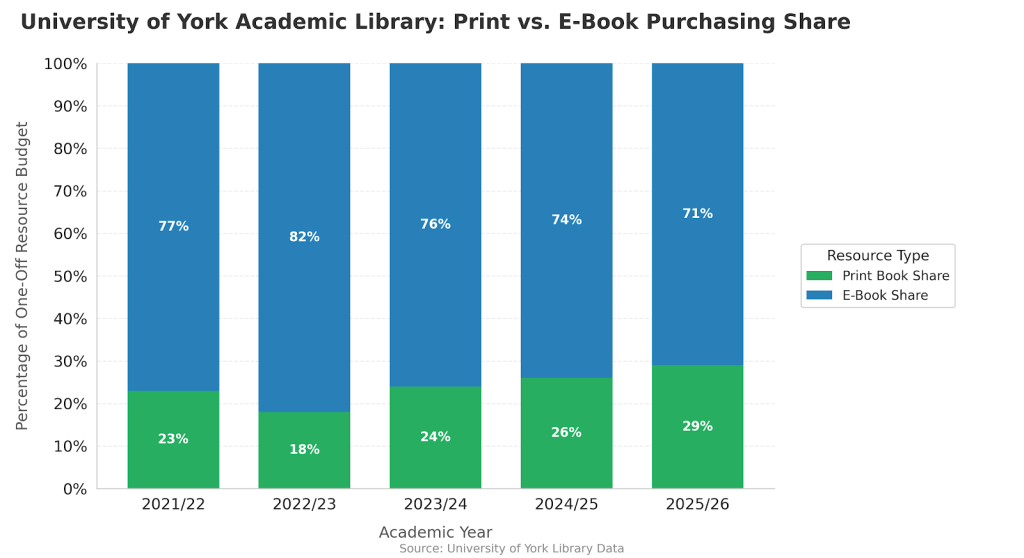
The digital age has fundamentally transformed the academic library, with the acquisition of e-books and online resources becoming the dominant force in collection development. The sheer volume, ease of remote access, and discoverability of electronic resources have undeniably reshaped scholarly research. To illustrate this seismic shift, consider the purchasing data for one-off resources at the University of York , where electronic resources have consistently commanded 70-80% of the total budget in recent years

Read More »

Do Audiobooks Count as Reading? (Spoiler: YES!)

I’ve spent a lot of time thinking about the Great Audiobook Debate. It sounds like a wrestling match in the book club, and honestly, it sometimes feels like one. You know the scene: you’re excited to discuss a new book, and you mention, “Oh, I listened to the audiobook,” only to have someone reply, “So, you didn’t actually read it?” Cue the eye-roll.

It’s an exhausting, circular argument, as old as audiobooks themselves and it’s one of those knotty problems that book lovers and library folks get stuck on.

It’s not as simple as “this one is good” and “this one is bad.” But, since you’re here, my professional opinion is a resounding YES, and you can tell them that a Librarian told you so.

Now, before anyone grabs their pitchforks (or their physical copies of War and Peace), let’s unpack this.

Image by Ri Butov from Pixabay

Read More »

5 Inconvenient Facts All Librarians Should Know About E-Books

During the Covid-19 pandemic, the promise of the digital library became clearer than ever. As physical doors closed, e-books offered a vital lifeline, foregrounding the incredible potential of on-demand access to information and culture. Yet this moment of digital promise also cast a harsh light on the dysfunctional infrastructure, predatory business models, and outdated legal frameworks that govern the lending of digital content.

For librarians on the front lines, the digital dream often clashes with a difficult daily reality. While lending a physical book is a straightforward and established process, licensing a digital one is complex, expensive, and often deeply frustrating. This has ignited a “palpable and widespread dissatisfaction” among library professionals who see a growing disconnect between their public mission and the commercial constraints of the e-book market.

This article uncovers five of the most impactful and often counter-intuitive realities that shape the world of e-lending today, revealing the hidden complexities that exist just beyond the reader’s click.

Image by Eli Digital Creative from Pixabay

Read More »

5 Facts All Librarians Should Know About Interlibrary Loans

The UKSG Insights article ‘Interlibrary loans, subscriptions and copyright in the UK academic library sector’ by my White Rose comrade, from University of Sheffield, Andrew Johnson, is an excellent summary of the current ILL situation, considering legal exceptions and some of the legislative grey areas that exist within the ecosystem.

I would encourage everyone to read it, as an educational and insightful explainer of complicated issues. I would also encourage anyone interested in expanding knowledge in this sphere of Librarianship to use ‘Exceptions for Libraries’ by renowned fonts of ILL knowledge Chris Morrison and Jane Secker as a good practical starting point.

Regarding Interlending, ILL, Interlibrary Loans, or whatever nomenclature you prefer to use, here are 5 facts that all Librarians should know…

Image by Nino Carè from Pixabay

Read More »