Buying and Managing E-Books for Acquisitions Librarians. Part 4 – Statistics & Promotion

In our previous post, we looked at the “invisible” life of an e-book once the invoice is paid. We explored the high-stakes world of metadata, the frustrations of DRM, and the ethical imperative of accessibility. We established that buying the book is only half the battle; the other half is ensuring it actually works for the human at the other end of the screen.

Here is a breakdown of the series so far:

But how do we know if it’s working? And once we have a collection that functions, how do we make sure people actually use it? Welcome to the latest part of my series, Buying and Managing E-Books for Acquisitions Librarians Part 4 – Statistics & Promotion.

Image by Pete Linforth from Pixabay

Statistics: The Signal, the Noise, and the Weapon

In the digital library, statistics are ubiquitous. We are currently awash in an exhausting volume of data, from COUNTER 5.1 reports to granular platform analytics, that promise to underpin our collection strategies. When harnessed correctly, this data is the engine of a truly dynamic service, it allows for Just-In-Time (JIT) acquisition and a responsive, data-driven strategy that mirrors the actual needs of our researchers and students in real-time.

Read More »

Buying and Managing E-Books for Acquisitions Librarians. Part 1 – Purchasing E-Books.

In the ever-evolving landscape of academic library collections, the shift toward digital has often been framed as a straightforward evolution, a simple migration from shelf to screen. Yet, as any Acquisitions Librarian can tell you, the reality of building a digital collection is a complex dance of licensing, logistics, and strategic negotiation. While our patrons see the convenience of a click, we navigate a labyrinth of platforms, permissions, and pricing models behind the scenes.

Welcome to the first post in my new series, Buying and Managing E-Books for Acquisitions Librarians. Over the coming weeks, I will be pulling back the curtain on the digital supply chain to explore methods of purchase, supplier relationships, and what happens next

My plan is to cover the following elements:

Image by Michael Haderer from Pixabay

Purchasing E-Books

1 – Supplier Type: Aggregators

Aggregators—such as ProQuest (Ebook Central), EBSCO, and VLeBooks—act as the massive department stores of the library world. They host content from thousands of different publishers on a single, unified platform, providing a centralized hub for discovery and management.

Read More »

5 Ways A Well-Designed Controlled Digital Lending Scheme (CDL) Can Improve Your Academic Library

If you’ve spent any time in a university library lately, you’ll know we’re living in a bit of a divided era. On one hand, we’ve got these magnificent, sometimes centuries old, print collections that user communities love and value (and honestly, who can blame them? There’s nothing like the smell of an old book). On the other, we’re battling a digital marketplace that feels increasingly like a wild west of restrictive licenses, rising costs, and content that can vanish at the whim of a platform update.

Enter Controlled Digital Lending (CDL)

While the legal headlines have been dominated by the high drama Hachette v. Internet Archive case in the US, a situation that has certainly set the cat among the pigeons, the UK conversation is much more grounded. We aren’t looking to create a “digital library of Alexandria” overnight, we’re looking for sensible ways to manage the resources we already pay for. As has been repeatedly highlighted in the SCONUL landscape review (and followup work) by the always excellent Jane Secker and Chris Morrison, CDL isn’t a radical hack, it’s a strategic way to bridge the gap between our physical past and our digital future.

Here are five ways a well-constructed CDL scheme can transform the academic library landscape in the UK.

Image by Pete Linforth from Pixabay

Read More »

Print Books vs E-Books: 5 reasons why print books persist in the digital age

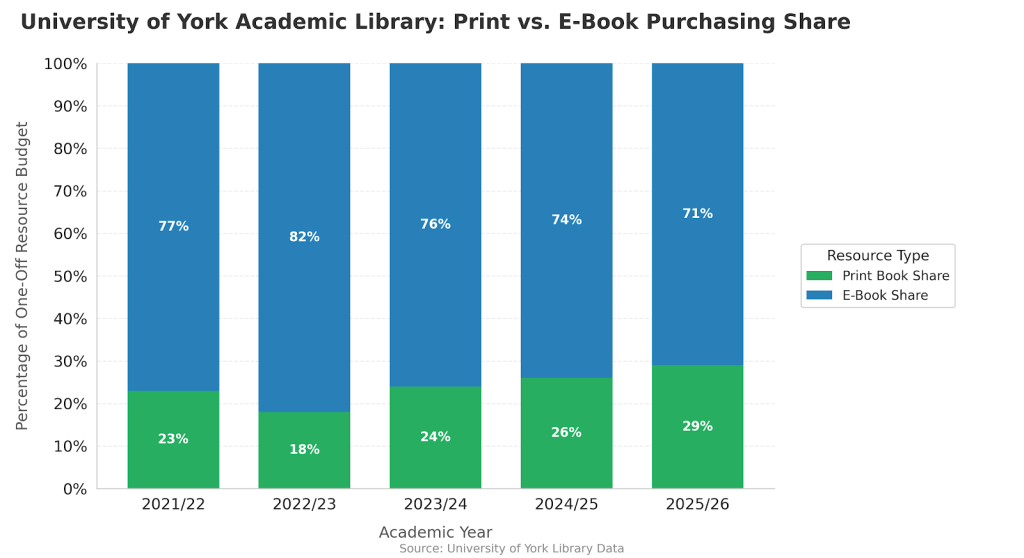
The digital age has fundamentally transformed the academic library, with the acquisition of e-books and online resources becoming the dominant force in collection development. The sheer volume, ease of remote access, and discoverability of electronic resources have undeniably reshaped scholarly research. To illustrate this seismic shift, consider the purchasing data for one-off resources at the University of York , where electronic resources have consistently commanded 70-80% of the total budget in recent years

Read More »

Do Audiobooks Count as Reading? (Spoiler: YES!)

I’ve spent a lot of time thinking about the Great Audiobook Debate. It sounds like a wrestling match in the book club, and honestly, it sometimes feels like one. You know the scene: you’re excited to discuss a new book, and you mention, “Oh, I listened to the audiobook,” only to have someone reply, “So, you didn’t actually read it?” Cue the eye-roll.

It’s an exhausting, circular argument, as old as audiobooks themselves and it’s one of those knotty problems that book lovers and library folks get stuck on.

It’s not as simple as “this one is good” and “this one is bad.” But, since you’re here, my professional opinion is a resounding YES, and you can tell them that a Librarian told you so.

Now, before anyone grabs their pitchforks (or their physical copies of War and Peace), let’s unpack this.

Image by Ri Butov from Pixabay

Read More »

5 Inconvenient Facts All Librarians Should Know About E-Books

During the Covid-19 pandemic, the promise of the digital library became clearer than ever. As physical doors closed, e-books offered a vital lifeline, foregrounding the incredible potential of on-demand access to information and culture. Yet this moment of digital promise also cast a harsh light on the dysfunctional infrastructure, predatory business models, and outdated legal frameworks that govern the lending of digital content.

For librarians on the front lines, the digital dream often clashes with a difficult daily reality. While lending a physical book is a straightforward and established process, licensing a digital one is complex, expensive, and often deeply frustrating. This has ignited a “palpable and widespread dissatisfaction” among library professionals who see a growing disconnect between their public mission and the commercial constraints of the e-book market.

This article uncovers five of the most impactful and often counter-intuitive realities that shape the world of e-lending today, revealing the hidden complexities that exist just beyond the reader’s click.

Image by Eli Digital Creative from Pixabay

Read More »

5 Facts All Librarians Should Know About Interlibrary Loans

The UKSG Insights article ‘Interlibrary loans, subscriptions and copyright in the UK academic library sector’ by my White Rose comrade, from University of Sheffield, Andrew Johnson, is an excellent summary of the current ILL situation, considering legal exceptions and some of the legislative grey areas that exist within the ecosystem.

I would encourage everyone to read it, as an educational and insightful explainer of complicated issues. I would also encourage anyone interested in expanding knowledge in this sphere of Librarianship to use ‘Exceptions for Libraries’ by renowned fonts of ILL knowledge Chris Morrison and Jane Secker as a good practical starting point.

Regarding Interlending, ILL, Interlibrary Loans, or whatever nomenclature you prefer to use, here are 5 facts that all Librarians should know…

Image by Nino Carè from Pixabay

Read More »

Pragmatic Principles

It’s been a tough old year. Ditching out of 7 R&P deals at once naturally brings with it a whole host of stressful situations to navigate. Through all of this, an absolutely excellent piece of work (that I am very proud we achieved) underpinned a huge amount of our strategic thinking and decision making.

Prior to any budget cuts, the decision had already been made that we in the Library should work with external colleagues to co-create a set of Library Collections Principles

When we set out on this journey, the goal was to create these principles in a way that contained a pragmatic understanding of the realities of collection acquisition, whilst also aligning closely with our University values, as well as speaking to the needs of our wider community.

Read More »

EBA v DDA – Which is best?

I posted on Linkedin a while ago about my overall views on EBA schemes, particularly in relation to DDA (or PDA) alternatives. I waffled on and ran out of words, happily now that I’ve set this blog up that is no longer an issue. So here is a post on all things EBA and DDA, happy reading.

What is an EBA?

An Evidence-Based Acquisition (EBA) scheme is a library acquisition model for digital content, most commonly e-books, where the library pays an upfront fee for a set period of time (usually a year) to provide its users with unlimited access to a large collection of titles from a publisher or aggregator.

Read More »

Ranking E-Book Licenses: A Tier List for Preference-Based Decisions

We all know that e-book licenses can be intentionally complex and confusing. The difficulty often lies in choosing between licenses that seem similar on the surface. For that reason, understanding the nuances of different licensing models is key to making better purchasing decisions. This ranking system provides a clear hierarchy for the most common types of e-book licenses, helping you to make preference-based decisions.

Note: This post is a list based purely on the elements of the license itself. In reality, other factors like price and the presence of robust and configurable auto-upgrade systems often play a huge role in the final decision.

Read More »