5 things for University Librarians to think about when exiting a Read and Public agreement

The landscape of UK higher education has recently shifted, with news that terms have been agreed with five major academic publishers via Jisc negotiations. While some might be tempted to view this as a “done deal,” another perspective would describe it as a pragmatic reflection from the sector that further negotiation on terms is simply no longer possible.

The harsh reality is that, given the severe financial challenges facing the sector, many of these agreements will remain fundamentally unaffordable for many institutions. This isn’t just a budgetary squeeze, it is a cliff edge. Difficult decisions regarding the deployment of available funds will need to be made with extreme speed, likely resulting in several institutions withdrawing from at least one major deal. At the University of York, our experience of withdrawing from seven Read and Publish (R&P) agreements as of the beginning of 2025 has shown that there is currently no roadmap or sufficient systemic help for exiting these Big Deals.

To that end, here are 5 key considerations to help navigate the complexities of an R&P exit. These are not exhaustive, nor are they universal, this is simply one University Acquisitions Librarian’s interpretation of a complex and stressful situation, with some practical tips in the hopes that others in a similar situation may find it helpful.

Image by Pexels from Pixabay

Read More »

5 Reasons OERs Could Unlock Opportunities for UK Academic Libraries

Adopt – Adapt – Create

Open Educational Resources (OERs) are freely accessible, openly licensed instructional materials, from full courses and textbooks to videos and images. They can be used, adapted, and shared by anyone. These resources embody the principles of openness and reuse, moving beyond the often restrictive models of traditional publishing.

While OER adoption is widespread in parts of North America and other regions, its integration into core teaching practice across the UK higher education landscape is still nascent. This early stage means that most institutions have significant untapped potential to leverage OER. For UK academic libraries, the traditional custodians of scholarly content, this presents a compelling opportunity to be at the forefront of an innovative movement.

Image by MasterTux from Pixabay

Read More »

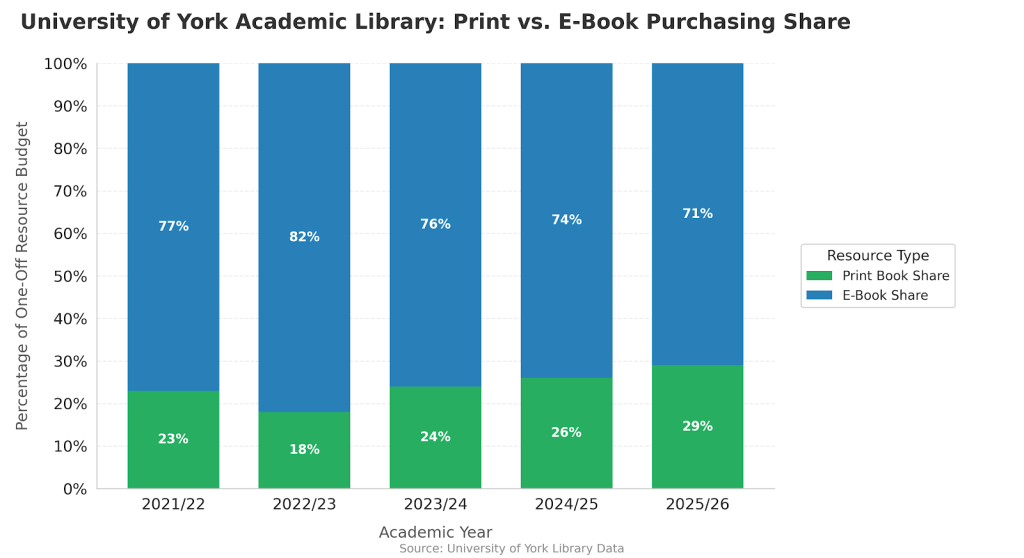
Print Books vs E-Books: 5 reasons why print books persist in the digital age

The digital age has fundamentally transformed the academic library, with the acquisition of e-books and online resources becoming the dominant force in collection development. The sheer volume, ease of remote access, and discoverability of electronic resources have undeniably reshaped scholarly research. To illustrate this seismic shift, consider the purchasing data for one-off resources at the University of York , where electronic resources have consistently commanded 70-80% of the total budget in recent years

Read More »

5 Inconvenient Facts All Librarians Should Know About E-Books

During the Covid-19 pandemic, the promise of the digital library became clearer than ever. As physical doors closed, e-books offered a vital lifeline, foregrounding the incredible potential of on-demand access to information and culture. Yet this moment of digital promise also cast a harsh light on the dysfunctional infrastructure, predatory business models, and outdated legal frameworks that govern the lending of digital content.

For librarians on the front lines, the digital dream often clashes with a difficult daily reality. While lending a physical book is a straightforward and established process, licensing a digital one is complex, expensive, and often deeply frustrating. This has ignited a “palpable and widespread dissatisfaction” among library professionals who see a growing disconnect between their public mission and the commercial constraints of the e-book market.

This article uncovers five of the most impactful and often counter-intuitive realities that shape the world of e-lending today, revealing the hidden complexities that exist just beyond the reader’s click.

Image by Eli Digital Creative from Pixabay

Read More »

Pragmatic Principles

It’s been a tough old year. Ditching out of 7 R&P deals at once naturally brings with it a whole host of stressful situations to navigate. Through all of this, an absolutely excellent piece of work (that I am very proud we achieved) underpinned a huge amount of our strategic thinking and decision making.

Prior to any budget cuts, the decision had already been made that we in the Library should work with external colleagues to co-create a set of Library Collections Principles

When we set out on this journey, the goal was to create these principles in a way that contained a pragmatic understanding of the realities of collection acquisition, whilst also aligning closely with our University values, as well as speaking to the needs of our wider community.

Read More »

EBA v DDA – Which is best?

I posted on Linkedin a while ago about my overall views on EBA schemes, particularly in relation to DDA (or PDA) alternatives. I waffled on and ran out of words, happily now that I’ve set this blog up that is no longer an issue. So here is a post on all things EBA and DDA, happy reading.

What is an EBA?

An Evidence-Based Acquisition (EBA) scheme is a library acquisition model for digital content, most commonly e-books, where the library pays an upfront fee for a set period of time (usually a year) to provide its users with unlimited access to a large collection of titles from a publisher or aggregator.

Read More »

The Differential Model – A gold standard acquisitions workflow

Everyone has an imaginary ideal acquisitions workflow, right…right?

If you don’t have your own, you can use mine. To explain, this is an acquisitions model that would fairly balance the need of Libraries to be selective and judicious in allocating their limited budgets to resources, whilst also accommodating the need for Publishers and Aggregators to make profits. This is not inherently a cost saving model, more of a cost reallocation model allowing Universities to direct their spend in a more strategic way

This is where the Differential Model comes in, a model that allows spending to be driven organically by need, ensuring our resources are directed to where they can have the greatest impact. The core principle involves re-profile spending away from speculative, front-loaded methods and towards a system that aligns with actual usage

Read More »

Ranking E-Book Licenses: A Tier List for Preference-Based Decisions

We all know that e-book licenses can be intentionally complex and confusing. The difficulty often lies in choosing between licenses that seem similar on the surface. For that reason, understanding the nuances of different licensing models is key to making better purchasing decisions. This ranking system provides a clear hierarchy for the most common types of e-book licenses, helping you to make preference-based decisions.

Note: This post is a list based purely on the elements of the license itself. In reality, other factors like price and the presence of robust and configurable auto-upgrade systems often play a huge role in the final decision.

Read More »